Palm Reading Online (Hast Rekha): Free Guided Reading
Scan your palm with a photo, or look at your own hand and compare it with simple drawings. In about three minutes you get a full palm reading in English or Hindi, with your hand type, every main line and your top strengths. The photo is read on your phone and never uploaded.
- 100% free
- No sign-up
- Runs in your browser
- Updated November 2026
1Read your palm
Hold your hand open and relaxed in good light, and compare it with the small drawings. One question at a time; skip anything you cannot see.
- About 18 quick questions, 3 minutes
- Reading in English or Hindi
- No upload, no sign-up
Scan: take or pick a photo of your open palm. We measure your hand shape and fingers and show where each line is on your own photo. The photo never leaves your phone. The first scan downloads about 10 MB.
3Prefer an AI reading? Copy a prompt for ChatGPT or Gemini
If you would rather have an AI app look at a photo of your palm, this prompt asks it to describe what it sees line by line, say when a line is unclear, and keep to traditional palmistry for fun.
Photo tips
- Hold the hand flat and open, fingers together, palm facing the camera.
- Use daylight from a window; avoid flash, which hides fine lines.
- Fill the frame with the palm and wrist, and crop out your face and anything personal.
The photo goes to the AI app you choose, under that app's own terms. It is never sent to MuftTools.in. MuftTools.in is not affiliated with OpenAI or Google.
Quick answer
MuftTools.in's palm reading tool guides you through your own hand one question at a time: which hand, palm shape and finger length (earth, air, fire or water hand), the heart, head, life, fate and sun lines, the relationship (marriage) lines and the mounts. Each option has a small drawing to compare with your palm. The answers are turned into a reading based on traditional palmistry and Indian hast rekha, in English or Hindi, which you can download as an image card or PDF. It runs in your browser and needs no photo. Palmistry is a tradition, not a science.
- What it reads
- Hand type, fingers and thumb, heart, head, life, fate and sun lines, relationship lines and mounts
- How
- Scan a photo of your palm (hand shape and fingers are measured, and each line is shown on your photo), or answer about 18 picture questions
- Language
- English or Hindi, switch any time
- Download
- Reading card (PNG) or full reading (A4 PDF)
- AI option
- A ready prompt to use with your own photo in ChatGPT or Gemini
- Privacy
- The photo is read in your browser and never uploaded or saved; answers stay in your browser
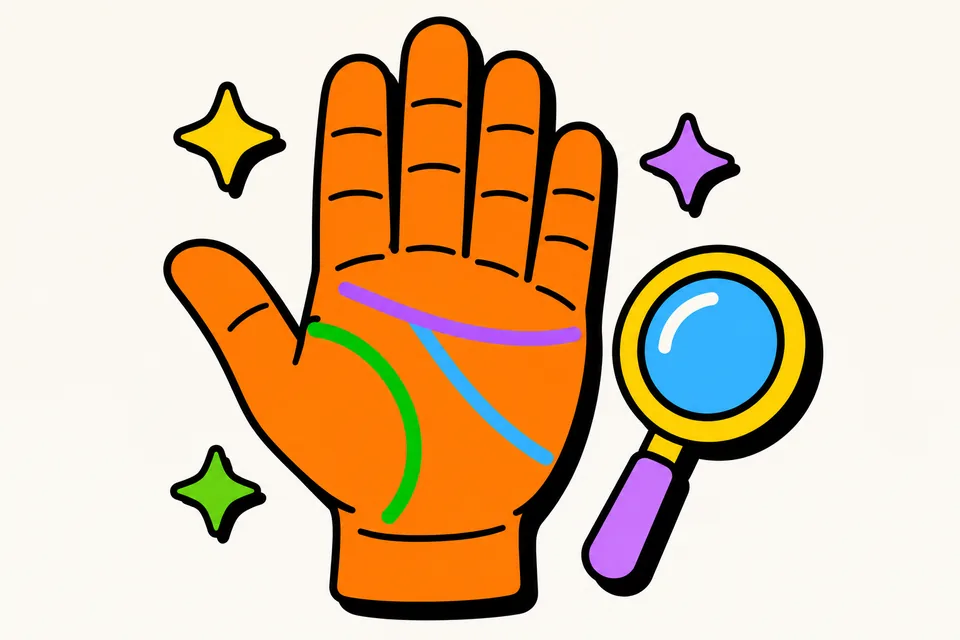
What palm reading is
Palm reading, or palmistry, is an old tradition of reading character from the shape of the hand and the lines on the palm. In India it is called hast rekha (हस्त रेखा) or hast samudrik, and it belongs to samudrika shastra, the traditional study of the body's features. Similar traditions grew up in China and Europe, so the same lines have both Indian and Western names.
Palmistry is a matter of belief, not science. No study has shown that the lines on the hand reveal personality or the future. Enjoy your result as a story about yourself to smile at and share, not something to plan your life around.
How to use this palm reading tool
- Sit in good light and hold your hand open and relaxed.
- Tap Start my reading, or Scan my palm to begin from a photo.
- For each question, pick the drawing closest to your hand. If you cannot see a line, tap not sure and it is left out.
- Read the result in English or Hindi, then download or share it.
Scan your palm with a photo
Tap Scan my palm and take or pick a photo of your open palm in daylight. Google's open-source MediaPipe hand model finds 21 points on your hand, and the page measures your palm shape, finger length and index against ring finger and fills in those answers for you to check. For every line it highlights the area to look at on your own photo. Palm lines change with light and angle, so you confirm what you see instead of the scanner guessing. The scanner downloads once (about 10 MB), runs on your phone, and your photo is never uploaded or saved.
Which hand to read
Most palmists read your dominant hand, the one you write with, as the life you are building now, and your other hand as the nature you were born with. An older Indian custom reads the right hand for men and the left hand for women. You can run the reading once for each hand and compare.
The hand types: earth, air, fire and water
Western palmistry groups hands into four types by two simple measurements. The palm is square if its width just below the fingers is about the same as its length from the wrist to the base of the middle finger, and rectangular if it is clearly longer. The fingers are long if the middle finger is about three quarters of the palm's length or more.
- Earth hand (prithvi): square palm, short fingers. Read as practical, steady and reliable.
- Air hand (vayu): square palm, long fingers. Read as curious, clever and good with words.
- Fire hand (agni): rectangular palm, short fingers. Read as energetic, warm and enthusiastic.
- Water hand (jal): rectangular palm, long fingers. Read as sensitive, imaginative and caring.
Guides do not all agree on the fire hand; one well-known guide describes it with a square palm. This tool follows the version most sources give, listed above.
The main lines and what palmists say about them
Heart line (hridaya rekha) is the top line across the palm, starting under the little finger. Palmists read it as feelings and relationships. Ending under the index finger is read as a warm, idealistic heart; ending between the index and middle fingers as balance; ending under the middle finger as a self-reliant heart that shows love through actions. A curved line is read as open and expressive, a straight one as calm and steady.
Head line (mastishk rekha) is the middle line, starting between the thumb and the index finger. It is read as the way you think. A long line suggests a thorough thinker, a short one a quick decider. A straight line is read as logical, a sloping one as imaginative. When it starts joined to the life line, palmists read a careful, thoughtful approach; a gap between them is read as early independence.
Life line (jeevan rekha) curves around the base of the thumb. Palmists read it as energy, zest for life and big life changes. A wide arc is read as plenty of energy, a line close to the thumb as calm energy and love of home. A second line beside it is read as extra support, and a break as a change of direction.
A short life line does not mean a short life. This is the most common myth in palm reading, and palmists themselves reject it: they say the length of the life line does not show how long anyone will live.
Fate line (bhagya rekha) runs up the middle of the palm toward the middle finger and is read as your sense of direction in work and life. Many people have no clear fate line, which palmists read as a self-made path. Where it starts matters too: from the wrist, early direction; from the life line, effort and family support; from the outer edge of the palm (the mount of the Moon), a path helped by other people.
Sun line (surya rekha) runs toward the ring finger and is read as creativity and talent that gets noticed. Many hands do not have one, and that is normal.
Relationship lines (vivah rekha) are the short lines on the edge of the palm below the little finger. Sources disagree a lot here: some count them as marriages, while others say only the clearest line matters. This tool reads them gently, as close emotional bonds, and never as a count of marriages or a date.
The mounts (parvat)
The soft pads of the palm are called mounts and are named after the planets: Jupiter (guru) under the index finger, Saturn (shani) under the middle finger, the Sun (surya) under the ring finger, Mercury (budh) under the little finger, Venus (shukra) at the base of the thumb and the Moon (chandra) on the outer edge near the wrist. Palmists read the fullest one as a strong side of your character.
Prefer an AI reading?
The prompt builder writes a careful prompt for ChatGPT or Gemini: it asks the AI to describe only what it sees, to say when a line is unclear and to avoid health or money predictions. That photo goes to the AI app you choose, under its own terms.
A palm reading is not a health check
A palm reading cannot tell you anything about your health, and this tool makes no health, lifespan or money predictions. If you notice a new mark, a change in the skin or nails, or pain in your hands, please see a doctor.
Frequently asked questions
How do I read my own palm online for free?
Tap Start my reading, choose the hand you are reading, then answer one question at a time by comparing your palm with the small drawings: palm shape, fingers, thumb, heart line, head line, life line, fate line, sun line, relationship lines and mounts. If you cannot see a line, tap "not sure" to skip it. Your reading appears at the end, in English or Hindi.
How does the palm scan work?
Take or pick a clear photo of your open palm in daylight. The scanner finds your hand, measures your palm shape, finger length and index against ring finger, and fills in those answers for you to check. For every line question it highlights the area to look at on your own photo, and you tap what you see. Palm lines are too faint and varied for a phone photo to read them reliably, so the lines are confirmed by you rather than guessed.
Which hand should I read, left or right?
Most palmists today read your dominant hand, the one you write with, as the life you are building now, and the other hand as the nature you were born with. An older Indian custom reads the right hand for men and the left hand for women. You can read both hands with this tool and compare them.
Is palm reading scientific?
No. Palmistry (hast rekha, part of samudrika shastra) is an old tradition and a matter of belief. There is no scientific evidence that the lines on the hand show personality or the future. Enjoy the reading for fun and self-reflection, and do not base important decisions on it.
Does a short life line mean a short life?
No. This is a common myth, and palmists themselves reject it. They say the length of the life line (jeevan rekha) does not show how long anyone will live; they read it as energy, zest for life and big life changes. Lines on the hand are skin creases, and their length is not a health sign.
What are the main lines on the palm called in Hindi?
The heart line is hridaya rekha (हृदय रेखा), the head line is mastishk rekha (मस्तिष्क रेखा), the life line is jeevan rekha (जीवन रेखा), the fate line is bhagya rekha (भाग्य रेखा), the sun line is surya rekha (सूर्य रेखा) and the short lines below the little finger are vivah rekha (विवाह रेखा), or marriage lines.
What does it mean if I have no fate line?
Many people have no clear fate line. Palmists read this as a self-made path: you shape your own direction rather than follow a fixed one. A missing fate line is common and is not a bad sign in palmistry.
Is my palm photo uploaded anywhere?
No. 'Scan my palm' reads the photo inside your browser with an open-source hand model (Google's MediaPipe), which finds 21 points on your hand to measure the palm and fingers and to show where each line is. The photo is not uploaded, not saved and is gone when you close the page. You can also skip the photo and just answer the questions.
Can I get the palm reading in Hindi?
Yes. Tap हिंदी at any point, before or after the questions, and the questions and the whole reading switch to Hindi. The downloaded card and PDF are made in the language you choose.
Can a palm reading tell me about my health?
No. A palm reading is not a health check, and this tool makes no health predictions. If you notice a change in the skin, colour or shape of your hands, please see a doctor.