Will Format Generator (Vasiyatnama)
List your family, your assets and who should get what, and get a clear will draft with an executor and an attestation block for two witnesses, in English or Hindi.
- 100% free
- No sign-up
- Runs in your browser
- Updated October 2026
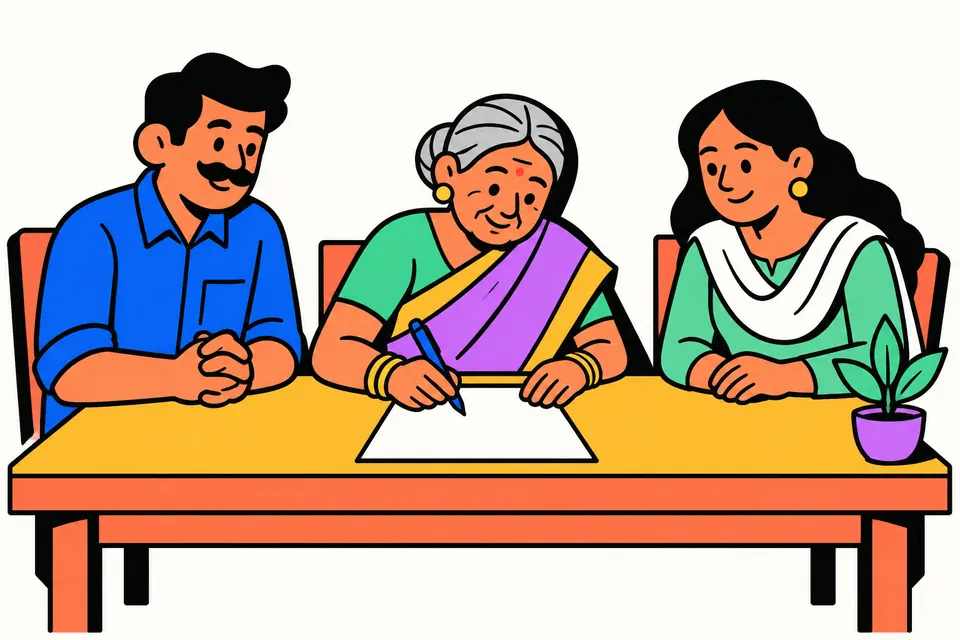
A clear will draft without starting from a blank page
Many families in India deal with property disputes simply because no will was written. A will (वसीयत) lets you say who gets your house, savings, jewellery and other assets after your death, and who should carry out your wishes. You don't need a special form or a lawyer to write one, but the wording should be clear and it must be signed and witnessed properly. This tool builds a plain-language draft from your answers, in English or Hindi, so you can read it, discuss it with your family and sign it.
There are two formats. "Who gets what" lists up to 8 gifts, says where the rest of your property goes, and covers what happens if someone you named dies before you. "Everything to one person" leaves your whole estate to one person, such as your spouse, with an alternate. Both include a revocation clause, a sound-mind declaration, an executor, a guardian wish for minor children, place and date, your signature and an attestation block for two witnesses.
How to use it
- Choose the format: who gets what, or everything to one person.
- Enter your details: name, father's or husband's name, age and address. The last 4 digits of Aadhaar are optional.
- List your family and main assets, one per line. Both lists are optional, but naming your family shows you thought about everyone.
- Say who gets what. Describe each item so it can be identified, then the person and their relation to you. Fill in "Everything else goes to" so nothing is left out.
- Name an executor and an alternate, and a guardian for minor children if you have any.
- Read the draft, download the PDF or Word file, print it and sign it in front of two witnesses.
What the law requires
The rules on making a will are in the Indian Succession Act, 1925. For wills of Hindus, Buddhists, Sikhs and Jains, section 57 and Schedule III apply a list of its sections, including 59, 61, 62 and 63 below:
- Who can make a will (section 59): any person of sound mind who is not a minor. A person who is deaf, mute or blind can make a will if they understand what they are doing. Nobody can make a will while so affected by illness, intoxication or anything else that they don't know what they are doing.
- Free will (section 61): a will, or any part of it, made because of fraud, coercion or pressure that takes away the person's free agency is void.
- Changing it (section 62): a will can be revoked or altered by its maker at any time while they are competent to make a will.
- Signing and witnesses (section 63): you sign or put your mark on the will so that it is clear you mean it as your will. At least two witnesses attest it. Each must have seen you sign, or received your personal acknowledgement of the signature, and each must sign in your presence. They need not be present at the same time, and no particular form of attestation is needed.
- Witnesses who benefit (section 67): where this section applies, the will stays valid but a gift to an attesting witness, or to the witness's husband or wife, is void. Schedule III doesn't list section 67 among the sections applied to wills of Hindus, Buddhists, Sikhs and Jains, but choosing witnesses who get nothing avoids the question for everyone.
- Muslims (section 58): this part of the Act doesn't apply to wills of Muslims, which follow Muslim personal law. It has its own rules on wills, so take a lawyer's advice.
Registration and safe keeping
Under the Registration Act, 1908, registering a will is optional (section 18) and can be done at any time (section 27). Many people still register it at the sub-registrar's office, because it gives extra proof that they made the will and a record stays with the registration office. Section 42 offers another option: you can deposit the will with a Registrar in a sealed cover, and it is opened after your death. Whatever you choose, tell the executor where the original is kept.
What to write, and what to avoid
| Do | Avoid |
|---|---|
| Describe each asset so it can be identified: house number and address, bank name with part of the account number, locker number | Vague lines such as "my property to my children" |
| Name each person fully, with relation | Nicknames only |
| Say where everything else goes | Leaving assets you buy later uncovered |
| Pick witnesses who get nothing under the will | Beneficiaries or their spouses as witnesses |
| Sign every page and the end, in the same way | Corrections that nobody initials |
A will can only deal with property you own. Ancestral or joint family property, and the money under a nomination in a bank account or insurance policy, can follow other rules. If your situation involves these, ask a lawyer.
Tax on inheritance
Money or property received under a will or by inheritance isn't taxed as a gift: section 92(3)(c) of the Income-tax Act, 2025 excludes it from the gift rule in section 92(2)(m). Income that the property earns later, such as rent or interest, is taxed in the hands of the new owner in the usual way.
Hindi wills
Choose हिन्दी and the whole will is written as a वसीयतनामा, from the opening declaration to the witnesses' attestation, with the verbs matching the testator's gender. Names and addresses can be typed in Hindi or left in English. Hindi prints correctly in the PDF.
This is a draft format, not legal advice. For a large or complicated estate, family business, property abroad or a likely dispute, have a lawyer check the will before you sign. Nothing you type leaves your browser: no upload, no sign-up and no watermark. To give property during your lifetime instead, see the gift deed generator.
Popular will formats
Frequently asked questions
What makes a will valid in India?
Under section 63 of the Indian Succession Act, 1925, you must sign the will (or put your mark on it), and at least two witnesses must attest it. Each witness must have seen you sign, or heard you acknowledge your signature, and must sign in your presence. Section 59 adds that the person making the will must be of sound mind and not a minor.
Does a will have to be registered?
No. Section 18 of the Registration Act, 1908 lists wills among documents whose registration is optional, and section 27 lets a will be registered at any time. Registering it gives extra proof that you made it, and section 42 also lets you deposit the will with a Registrar in a sealed cover.
Does a will need stamp paper?
The Indian Succession Act doesn't ask for stamp paper. What it requires is your signature and two attesting witnesses. If you register the will, the sub-registrar's office will tell you the fees that apply in your state.
Can a beneficiary sign as a witness?
Avoid it. Where section 67 of the Indian Succession Act applies, the will stays valid but any gift to an attesting witness, or to the witness's husband or wife, is void. Section 67 isn't among the sections Schedule III applies to wills of Hindus, Buddhists, Sikhs and Jains, but witnesses who get nothing under the will avoid any question.
Can I change my will later?
Yes. Section 62 lets you revoke or alter a will at any time while you are able to make one. Make a new will that revokes the earlier ones, signed and witnessed in the same way. This tool's first clause revokes all earlier wills.
Does this format work for Muslims?
Section 58 says this part of the Indian Succession Act doesn't apply to wills of Muslims, which follow Muslim personal law. Muslim law has its own rules on wills, so a Muslim should ask a lawyer before using any will format.
Is property received under a will taxed?
Not as a gift. Section 92(3)(c) of the Income-tax Act, 2025 excludes money or property received under a will or by inheritance from the gift rule in section 92(2)(m).
Can I write my will in Hindi?
Yes. Choose हिन्दी and the whole will is written as a वसीयतनामा, including the attestation by the witnesses. Hindi prints correctly in the PDF and Word file.